

Darvaza Gas Crater, Turkmenistan
Discover one of Turkmenistan’s most extraordinary landscapes in the heart of the Karakum Desert. Known around the world as the “Gates of Hell,” the Darvaza Gas Crater is most dramatic from sunset into the night, when its glow becomes visible across the surrounding desert.
Use this guide to plan your visit, understand the crater’s story, choose the best time to go and find the most suitable route to Darvaza.
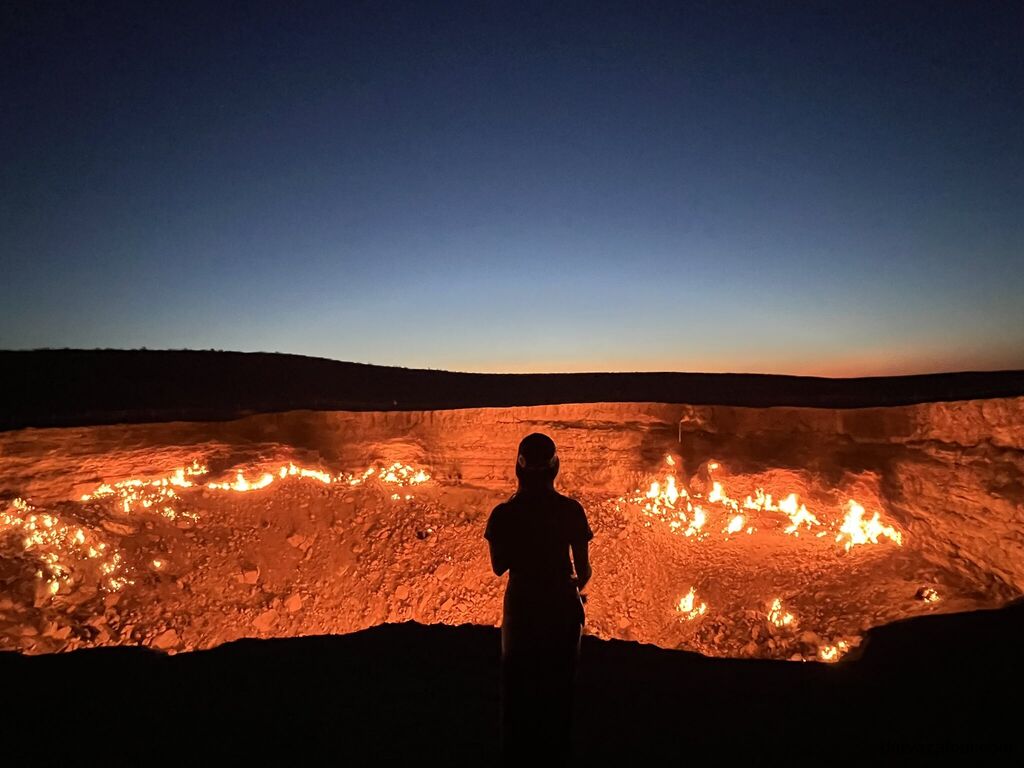
What Is the Darvaza Gas Crater?
The Darvaza Gas Crater is a large natural-gas crater located in the Karakum Desert of Turkmenistan. Gas escaping from beneath the ground burns across different parts of the crater floor, creating the orange glow that makes Darvaza especially striking after dark.
Unlike a conventional volcanic crater, Darvaza is associated with an underground natural-gas field. Its unusual appearance, remote desert setting and continuously burning flames have made it one of the most recognizable sights in Turkmenistan.
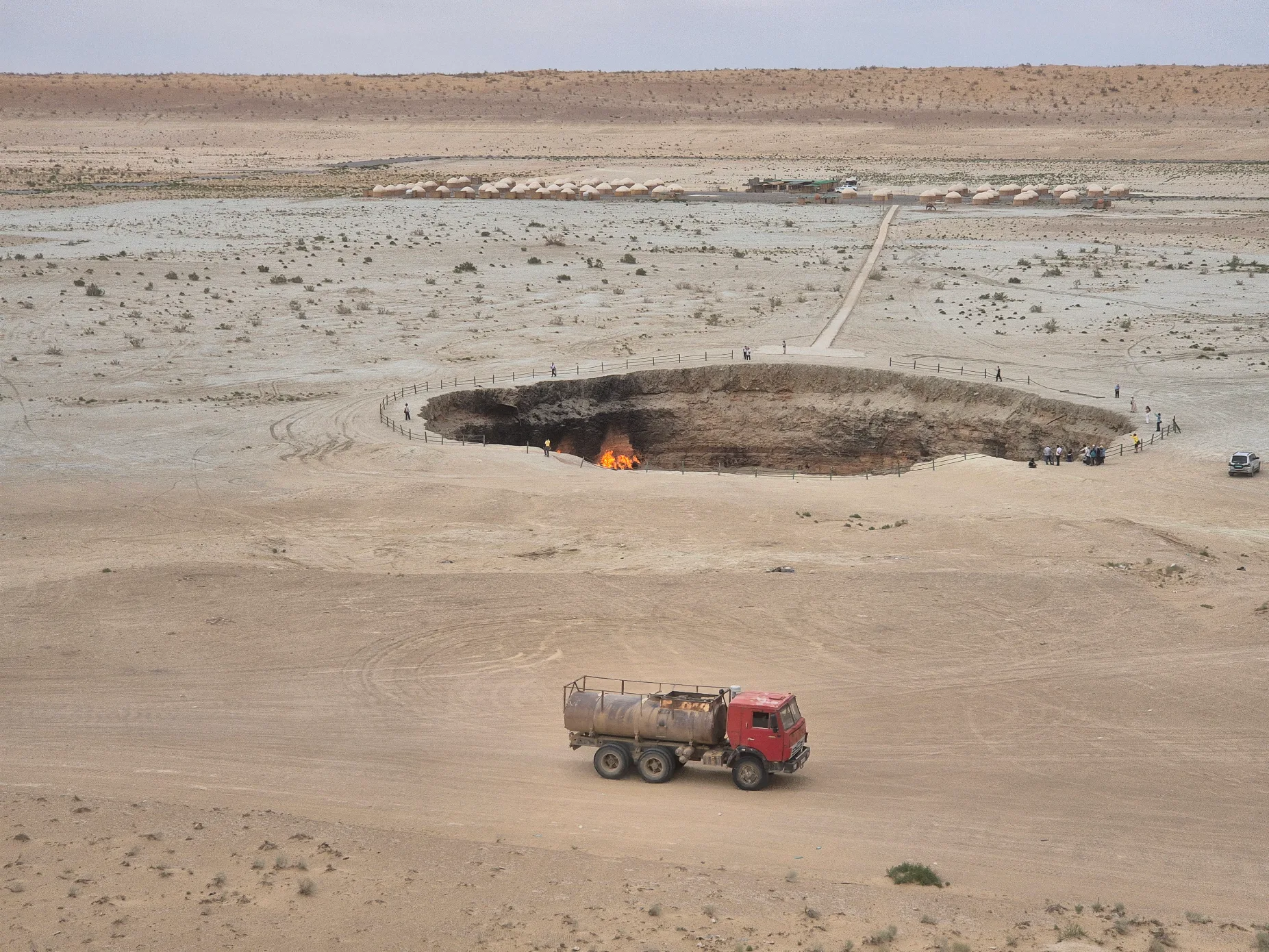
Visitors normally approach the crater by road across the Karakum Desert and can walk around designated areas near its rim. The experience changes considerably with the light: during the day the scale of the crater is easier to appreciate, while after sunset the flames become the dominant feature of the landscape.
Darvaza at a Glance
Location
Karakum Desert, Turkmenistan
Landscape
Desert gas crater with continuously burning natural-gas vents
Best Viewing
Late afternoon, sunset and after dark
Visit Style
Day visit or overnight stay near the crater
The History of the Darvaza Gas Crater
The story of the Darvaza Gas Crater is one of the reasons the site has become so famous, but its exact origins are less certain than many travel articles suggest.
The best-known version says that Soviet geologists were exploring for natural gas in the Karakum Desert when drilling operations exposed an underground cavity. The ground beneath the equipment collapsed, leaving a large crater from which natural gas began to escape. According to the popular account, the gas was then deliberately ignited in an attempt to prevent uncontrolled methane emissions, with the expectation that the fire would burn out after a short period.
That version is often dated to 1971, but the historical record is not clear. Researchers and explorers who have investigated the site have noted that reliable contemporary documentation is difficult to find. Local Turkmen geologists have also described a different timeline, suggesting that the crater may have formed during the 1960s and that the gas was not ignited until later, possibly in the 1980s.
What is certain is that the crater is connected with Soviet-era gas exploration in a region rich in natural-gas deposits. Once the escaping methane was ignited, the flames continued for decades, fed by gas rising from beneath the surface. Over time, the site changed from an industrial accident in a remote part of the Karakum into one of the most recognizable landmarks in Turkmenistan.
The lack of a fully documented origin has become part of the crater’s identity. Different dates and explanations continue to appear in books, travel guides and media reports, which is why it is better to treat the familiar “1971 drilling accident” story as the most widely repeated version rather than as a completely verified historical fact.
Today, the mystery surrounding its beginning adds another layer to the experience of visiting Darvaza. Travelers arrive to see a landscape that has been burning for generations, while the precise sequence of events that created it remains partly unresolved.
Best Time to Visit the Darvaza Gas Crater
Best Seasons to Visit Darvaza
Spring — March to May
Spring is one of the most comfortable periods for visiting Darvaza. Daytime temperatures are generally pleasant, while evenings in the desert can still feel cool. It is a good season for travelers who want to avoid both the strongest summer heat and the colder winter nights.
Summer — June to August
Summer in the Karakum Desert can be extremely hot during the daytime. Visits are more comfortable later in the afternoon and evening, when temperatures begin to fall. Travelers should be prepared for strong sun and high daytime heat.
Autumn — September to November
Autumn is another particularly good time to visit. Temperatures become more comfortable after summer, and the weather is generally well suited to desert travel. Evenings and early mornings become noticeably cooler later in the season.
Winter — December to February
Winter visits are possible, but nights in the desert can be cold. Warm clothing is important, especially for travelers staying overnight. Camps can prepare yurts for colder conditions with heaters, additional blankets and sleeping bags when needed.
Best Time of Day to Visit Darvaza
Late Afternoon
Arriving at Darvaza in the late afternoon is a good way to begin the visit, because there is still enough daylight to appreciate the full scale of the crater and the openness of the surrounding Karakum Desert.
At this time of day, the landscape is easier to read: the crater rim, surrounding tracks and distant desert horizon are clearly visible, and the softer light can make the scenery more interesting for photography than the harsh midday sun.
Late afternoon also gives travelers time to explore the area at a relaxed pace before sunset. You can see how the crater sits within the wider desert landscape, take photographs from different viewpoints and watch the light gradually change as evening approaches.
For visitors who want to experience Darvaza both in daylight and after dark, arriving in the late afternoon is the most practical choice, as it creates a natural transition into sunset and the evening viewing period.
Sunset
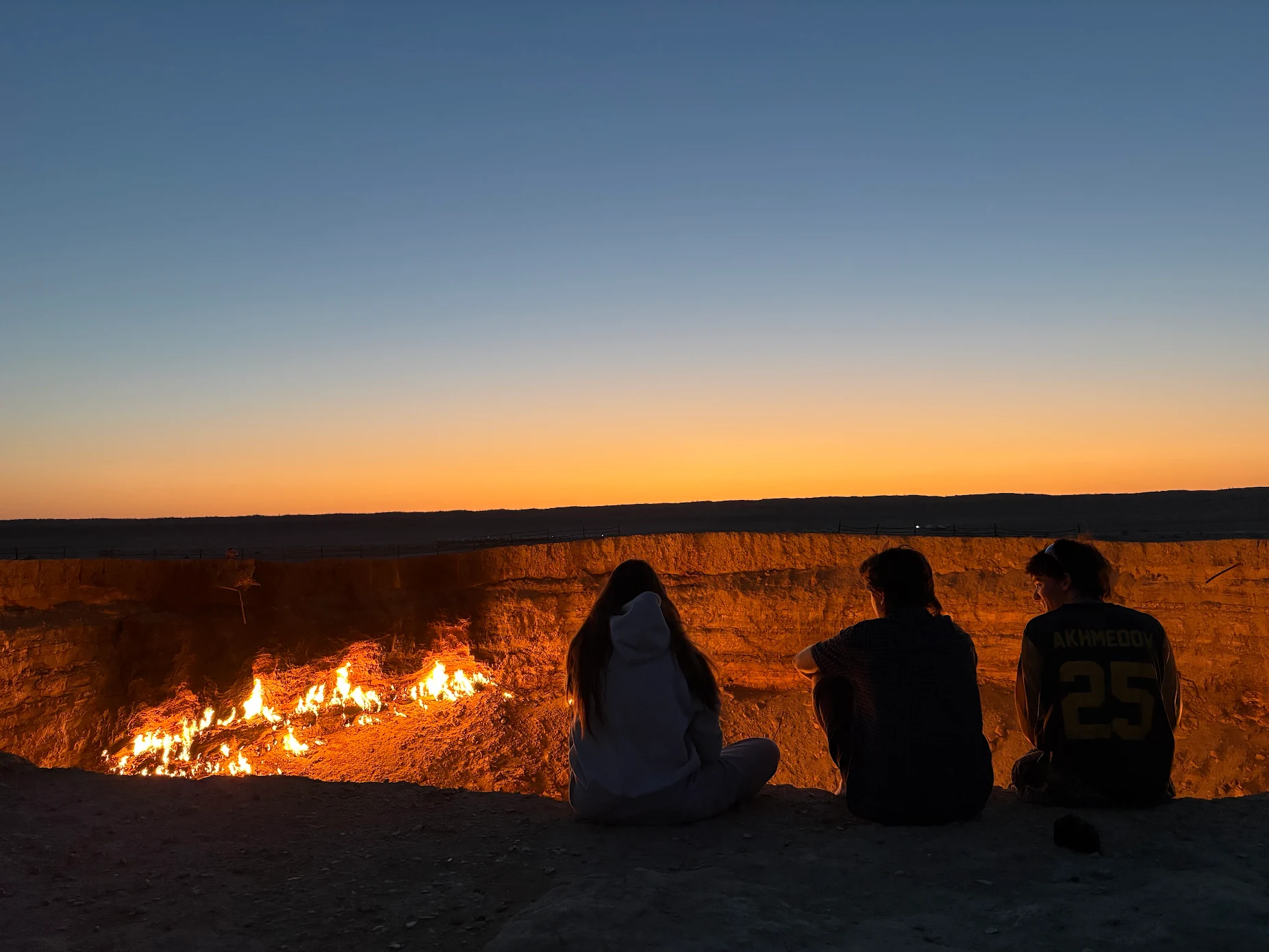
Sunset is one of the most memorable moments at Darvaza because the character of the landscape changes very quickly as daylight begins to disappear. The pale colors of the Karakum Desert become warmer, while the orange glow from the crater gradually becomes more visible.
This period creates a strong contrast between the open sky, the darkening desert and the flames below. For photography, it is especially interesting because the scene still retains detail in the surrounding landscape while the fire is already becoming a dominant visual element.
The transition itself is part of the experience. Rather than arriving only after dark, staying through sunset allows you to watch Darvaza change minute by minute, from a desert crater visible in natural light into the glowing landmark most travelers associate with the site.
Weather and cloud conditions can make every sunset look different, but the combination of fading daylight and the crater’s fire usually makes this one of the most atmospheric parts of a visit.
After Dark
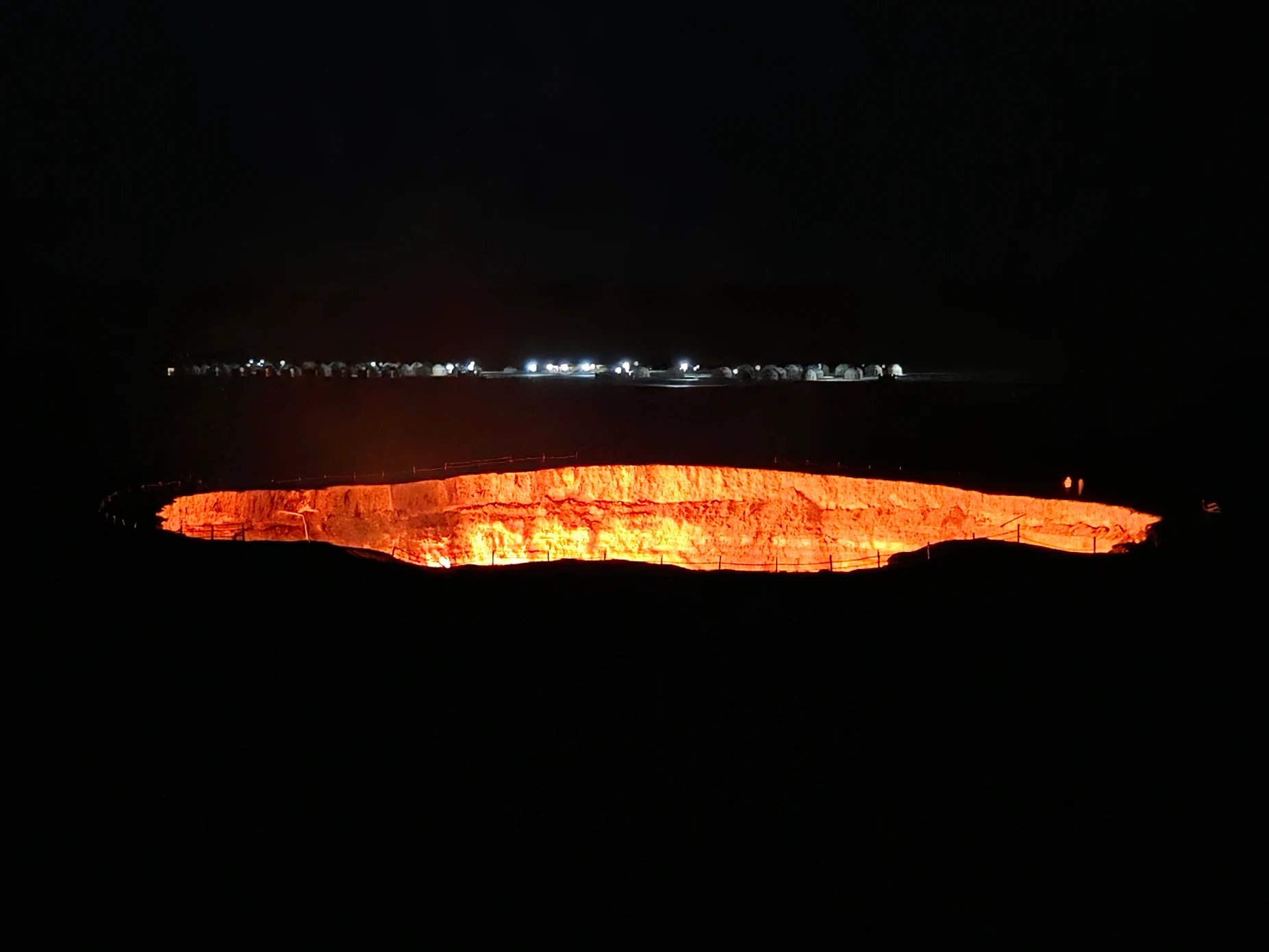
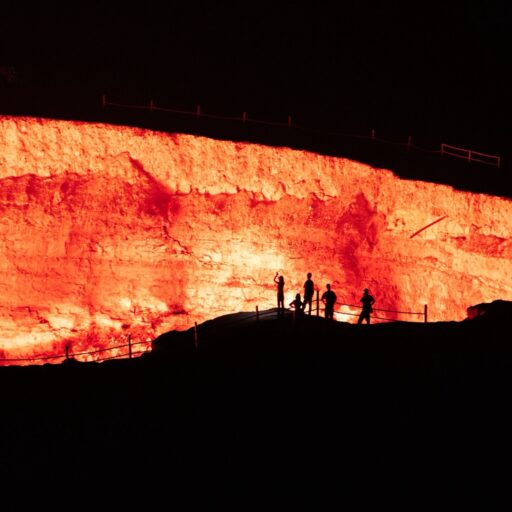
After dark, the Darvaza Gas Crater becomes dramatically more intense. With the surrounding Karakum Desert almost completely black, the flames and orange glow inside the crater stand out much more strongly than they do during the day.
The night view is the image most travelers associate with Darvaza. From the rim, the fire appears brighter and deeper, while the darkness around the crater makes the entire scene feel more isolated and atmospheric.
The sound of the burning gas, the heat rising from the crater and the absence of city lights all contribute to the experience. On clear nights, the contrast between the glowing crater and the open desert sky can be especially striking.
For many visitors, this is the highlight of the trip. Staying until full darkness allows you to experience Darvaza at its most recognizable and creates a very different impression from seeing the crater only in daylight.
How to Get to the Darvaza Gas Crater
Darvaza lies in the Karakum Desert between Ashgabat and northern Turkmenistan. The best route depends on where you enter the country, with travelers most commonly approaching from Ashgabat, the Shavat border near Khiva, or the Farab border near Bukhara.
From Ashgabat
Ashgabat → Karakum Desert → Darvaza
Ashgabat is the most straightforward starting point for a visit to Darvaza. Travelers leave the capital by road and continue north through the Karakum Desert toward the crater area.
The final part of the journey leaves the main road and continues across desert tracks to reach the crater. For this section, suitable transport is arranged as part of the tour.
This route works particularly well for travelers arriving at Ashgabat International Airport or for those who want to combine a city visit with an evening at Darvaza.
From Khiva / Shavat Border
Khiva → Shavat Border → Kunya-Urgench → Darvaza
Travelers coming from Uzbekistan can enter Turkmenistan through the Shavat border crossing near Khiva. After completing border formalities, the journey continues through northern Turkmenistan.
A common route combines the UNESCO-listed monuments of Kunya-Urgench with the drive south toward the Karakum Desert and Darvaza, making it possible to connect Khiva with one of Turkmenistan’s best-known attractions in the same itinerary.
This is one of the most convenient overland options for travelers combining Uzbekistan and Turkmenistan.
From Bukhara / Farab Border
Bukhara → Farab Border → Merv → Ashgabat → Darvaza
Darvaza can also be included in an overland journey entering Turkmenistan from Bukhara through the Farab border. Because Farab is located far to the east of the crater, this route is normally part of a longer itinerary rather than a direct trip to Darvaza.
Travelers commonly continue through Ancient Merv and Ashgabat before heading north into the Karakum Desert. This makes the Farab route particularly suitable for visitors who want to cross Turkmenistan from east to north while seeing several of the country’s major historical and cultural sites along the way.
Whichever route you choose, the last approach to Darvaza involves desert driving, so transport to the crater is arranged according to the route and group size.
Overnight Stay Near the Darvaza Gas Crater
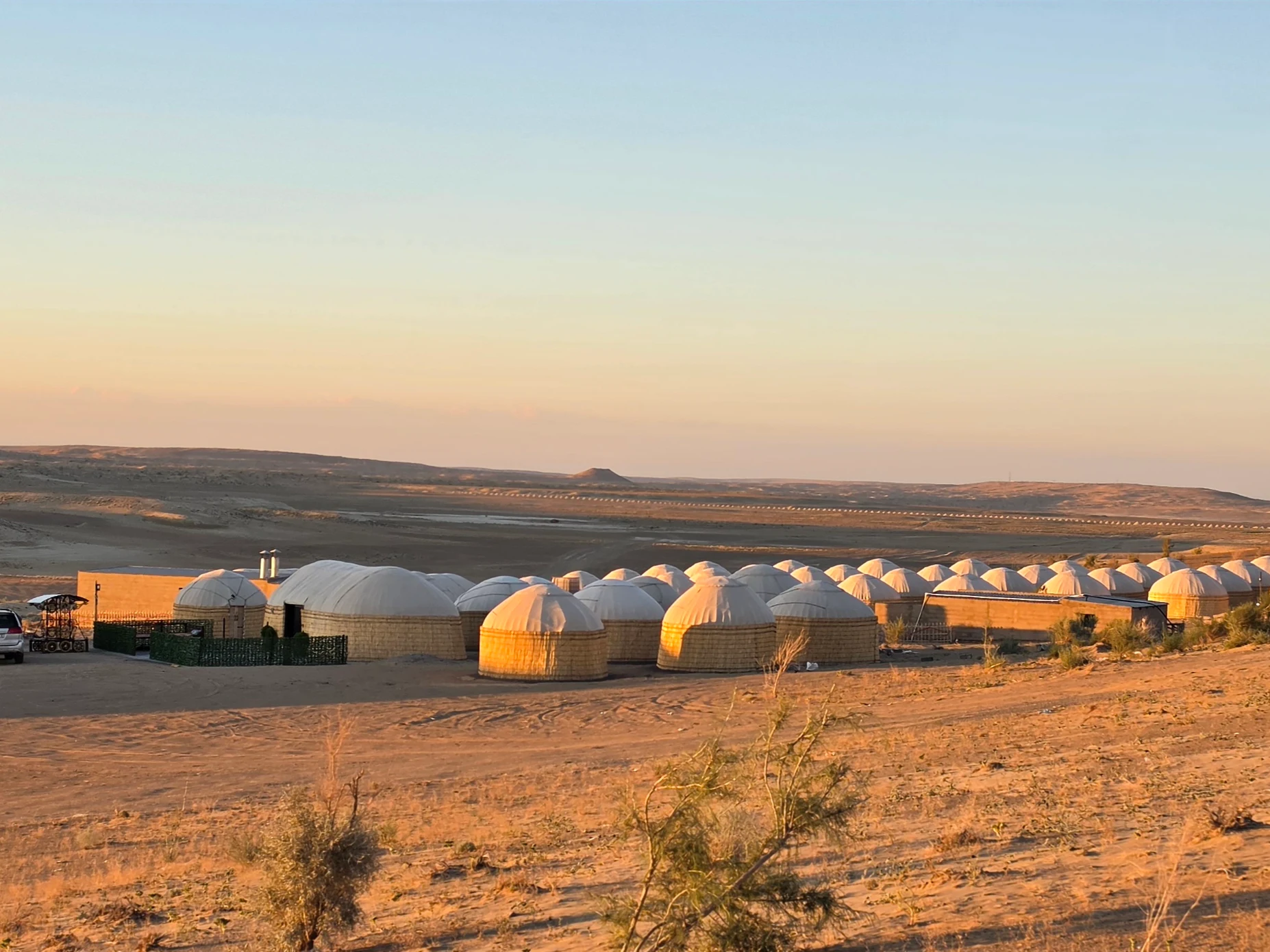
Staying overnight near the Darvaza Gas Crater is one of the most popular ways to experience the area, especially for travelers who want to remain in the desert after dark rather than return immediately to the main road.
An overnight stay allows you to enjoy the crater in the evening and experience the quieter atmosphere of the Karakum Desert once the main sightseeing period is over. Depending on the itinerary, travelers can stay in a traditional-style yurt camp located near the crater.
Accommodation at the camp is simple and designed for a desert setting rather than hotel-style comfort. Dinner and breakfast are normally provided, and basic toilet and shower facilities are available. Mobile reception can be weak in the desert, and Wi-Fi should not be expected.
During colder periods, yurts can be prepared with heaters, additional blankets and sleeping bags when required. Travelers who prefer more privacy can also request a private yurt, subject to availability.
For detailed information about accommodation, facilities, meals and what to bring, see our dedicated guide to Darvaza Yurt Camp.
What to Expect at the Darvaza Gas Crater
A visit to Darvaza is a desert experience rather than a conventional sightseeing stop. The surroundings are remote and open, so a little preparation makes the visit much more comfortable.
Desert Terrain
Expect open desert surroundings, sand and uneven ground around the crater area. Comfortable closed shoes are a better choice than sandals, especially if you plan to spend time walking around and taking photographs.
Changing Temperatures
Temperatures can change noticeably between daytime and evening. Even after a warm day, the desert may feel much cooler once the sun goes down, so carrying an extra layer is useful.
What to Bring
Water, sun protection, comfortable footwear and a light jacket are useful for most visits. In colder months, warmer clothing becomes especially important.
Photography
Darvaza offers very different photo opportunities in daylight, at sunset and after dark. A phone is enough for casual photos, while a camera with good low-light performance or a tripod can be useful for night photography.
Tours Including the Darvaza Gas Crater
Explore our current Turkmenistan tours that include a visit to the Darvaza Gas Crater. Choose a short trip focused on Ashgabat and Darvaza or combine the crater with Merv, Kunya-Urgench, Yangykala and other destinations across Turkmenistan.
3-Day
Private / Small Group
3-Day Tour: Farap ↔ Shavat via Merv, Ashgabat, Darvaza & Kunya-Urgench
Available from: Bukhara / Farap, Khiva / Shavat
Travel between Farap and Shavat in either direction, visiting Merv, Ashgabat, Darvaza and Kunya-Urgench on a compact 3-day journey.
1 traveler — US$ 1154 pp
4+ travelers — US$ 598 pp
5-Day
Private / Small Group
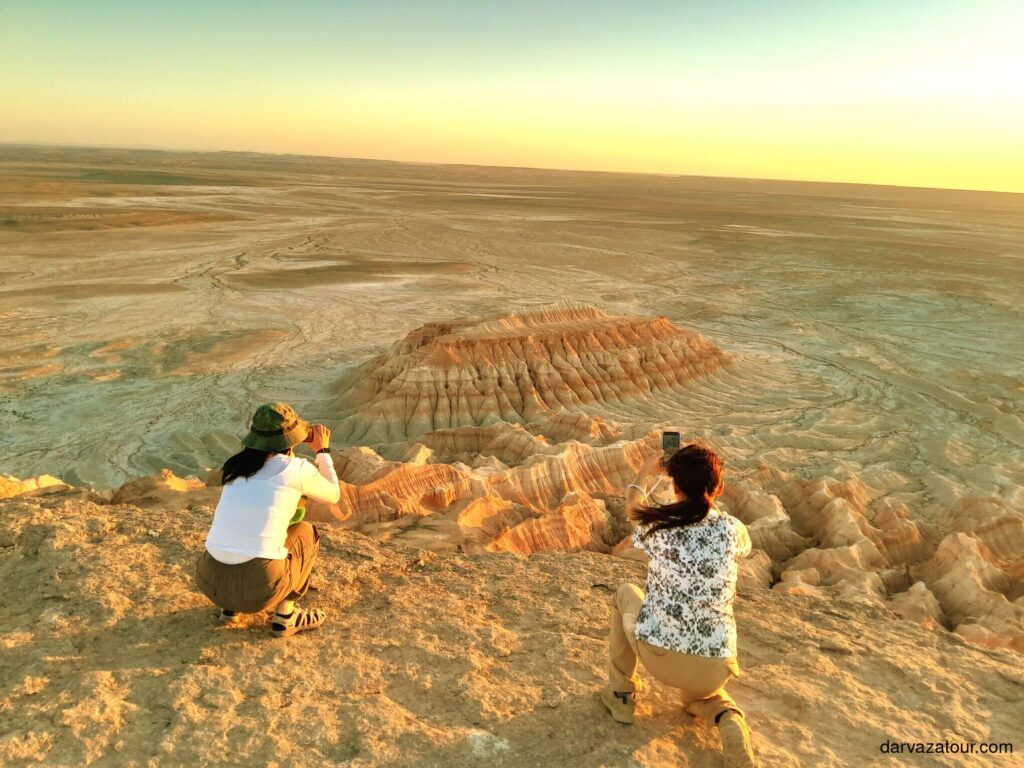
5-Day Tour: Farap ↔ Shavat via Merv, Ashgabat, Yangykala, Darvaza & Kunya-Urgench
Available from: Bukhara / Farap, Khiva / Shavat
Travel between Farap and Shavat in either direction on a 5-day journey through Merv, Ashgabat, Yangykala, Darvaza and Kunya-Urgench, combining ancient heritage, dramatic landscapes and Turkmenistan’s most iconic sights.
1 traveler — US$ 1629 pp
4+ travelers — US$ 914 pp
4-Day
Private / Small Group
4-Day Tour: Farap → Shavat via Merv, Mary, Ashgabat & Darvaza
Available from: Bukhara / Farap
Explore Merv, Mary, Ashgabat and the Darvaza Gas Crater on a 4-day overland tour from Farap to Shavat, combining Silk Road history, city sightseeing and the Karakum Desert.
1 traveler — US$ 1311 pp
4+ travelers — US$ 734 pp
Frequently Asked Questions About the Darvaza Gas Crater
Why does the Darvaza Gas Crater burn?
Natural gas escaping through vents beneath the crater fuels the flames visible across its floor. The site is associated with a natural-gas field in the Karakum Desert.
Can I visit Darvaza during the daytime?
Yes. Daylight makes it easier to appreciate the size of the crater and surrounding desert, although the flames become much more visually striking after sunset.
What is the best time of day to visit?
For the fullest experience, arrive in the late afternoon, stay through sunset and remain until after dark.
Can I stay overnight near the crater?
Yes. Many itineraries include an overnight stay at a yurt camp near Darvaza. More detailed information is available in our Darvaza Yurt Camp guide.
How do travelers reach the crater?
Darvaza is reached by road through the Karakum Desert. The final approach involves desert tracks, so suitable transport is arranged as part of the tour.
Can I visit Darvaza from Khiva or Bukhara?
Yes. Travelers can enter Turkmenistan from Uzbekistan through the Shavat border near Khiva or the Farab border near Bukhara and include Darvaza in a longer overland itinerary.
What should I bring to Darvaza?
Comfortable footwear, water, sun protection and an extra layer for the evening are useful. Warmer clothing is recommended during colder months.
Can I take photos at the crater?
Yes. The crater offers very different photography conditions during daylight, sunset and darkness. A tripod can be useful for longer night exposures.
Plan Your Visit to the Darvaza Gas Crater
Ready to plan your visit to Darvaza? You can explore our current Darvaza tours using the button above, or contact us directly if you would like help choosing the right itinerary or creating a private trip based on your travel dates and route.