

Alabai's work begins on a desert night
A watchdog quietly playing chess with a wolf
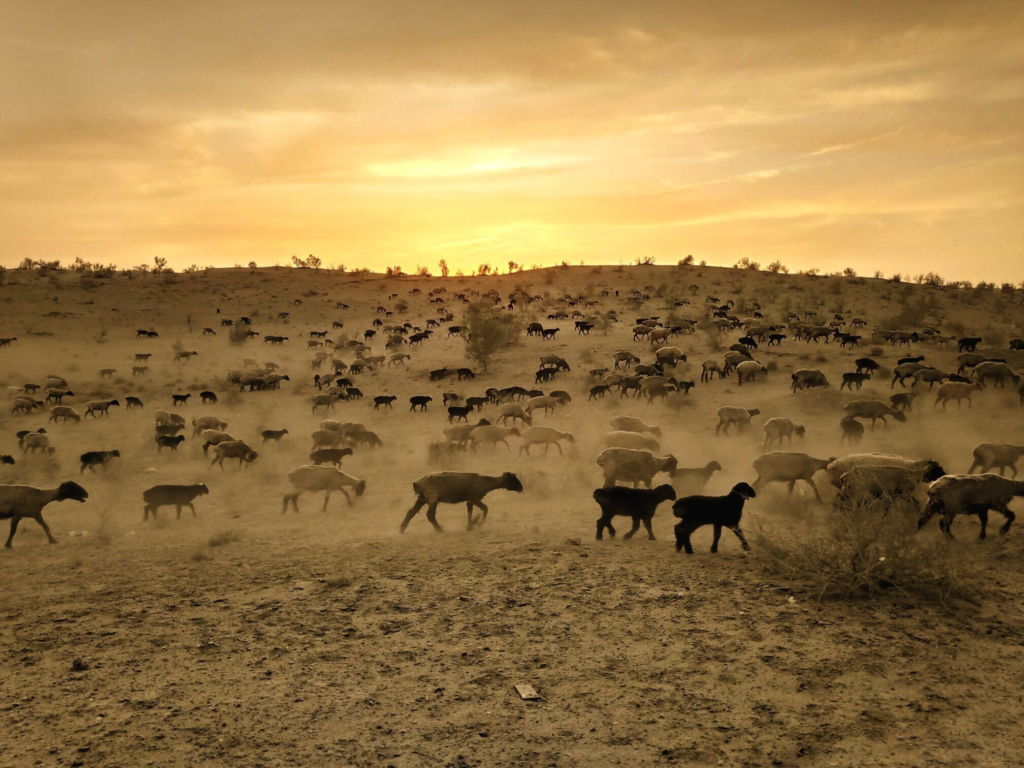
At night in Turkmenistan's Karakum Desert, not only humans but also "guard dogs" are on duty.
On the pitch-black sand dunes, giant dogs called alabai quietly protect flocks of sheep and the nomadic lifestyle from wolves.
In this article, I will introduce the alabai's nighttime work, personality, and presence in Turkmenistan's culture from a traveler's perspective, based on what I have observed since I was a child.
Night comes very quickly in the desert. Where just a moment ago a pink sunset lingered over the Karakum Desert, the sky is now a deep purple, and only a thin crescent moon hangs above the horizon.
The wind has died down, and the sheep curl up close together, sniffing the cool air.
The shepherd adjusts his chalat (cloak), takes a sip of chai-infused piala, and takes one last look around at his flock. But he is not alone on watch that night.
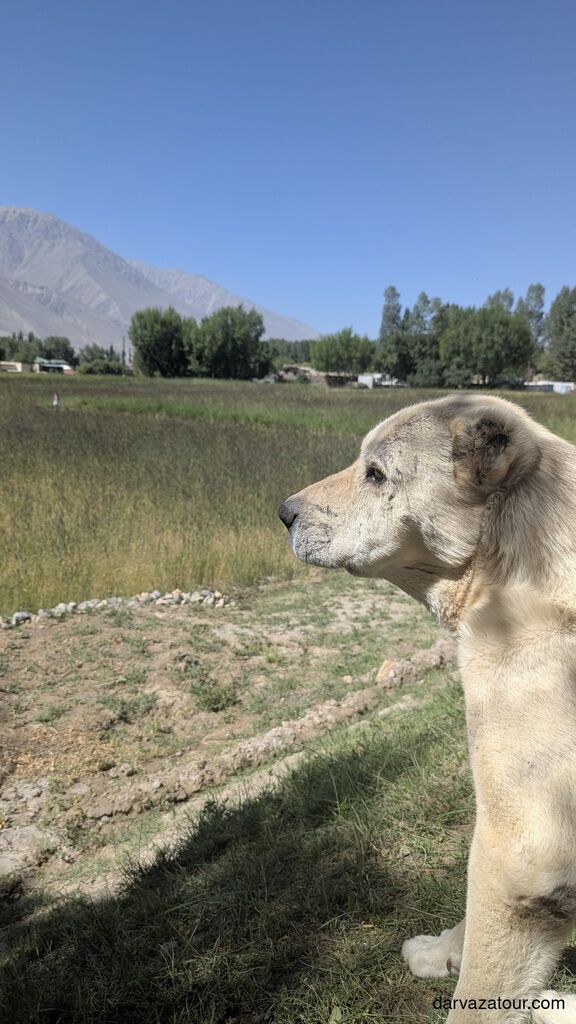
On a slightly elevated sand hill lies an Alabai, a huge Turkmen wolf-dog.
Its white fur blends with the color of the burnt sand, but its two black eyes never leave the darkness.
A little below, two other dogs appear to be dozing. Though they appear to be slumbering, their ears are constantly active, picking up even the faintest sounds of the desert.
Alabai spend most of their time lying down, which may be why they are able to remain alert at all times of the day.
From afar, a long drawn-out wolf howl can be heard.
The shepherd sighed softly and muttered, "He's come again tonight..."
For the wolves it's hunting time, they always attack at night, for the sheep it's a matter of life and death, and for the Alabai it's just another night shift.
A wolf emerges from the shadows
Wolves rarely come at you head on. They don't like to fight fair, they prefer to play it "slyly."
First, a shadow appears in the distance, perched on the top of a dune for just a moment, as if passing by by chance, stands with its back to you, and then quickly disappears into the darkness again.
To an inexperienced dog, this is a total provocation.
"There's only one wolf. I'll go after him now..."
Thinking this, the dog takes off running after the "lonely wolf."
But the Turkmen Alabai are different.
From the top of the hill, they peer into the darkness, knowing full well that a lone wolf never comes alone, and that if one shows up, it means that somewhere nearby, there's an entire pack hiding .
The Alabai does not stand up immediately.
First, he gives a low, long growl. This is a signal to the other dogs.
The second dog stands close to the flock (sheep), while the third moves slightly to the side to protect the flank.
The sheep begin to scratch the ground anxiously with their hooves, and the shepherd can tell right away, even though he is still lying down.
This means that a ``defensive formation'' is in place .
How do Alabai "divide roles"?
Wolves rely on cunning and stamina, while Alabai rely on experience and teamwork .
First, one Alabai steps forward , a little ways from the rest of the herd, to the edge of safety, and faces the shadow in the darkness.
"If you take even one step in here, you won't get away with it."
This is something we need to clearly communicate to the wolves.
The Alabai does this.
- They roar low and loud. The Alabai's roar sounds like a lion's roar.
- It quickly jumps back and forth and then back down, looking ready to pounce at any moment.
- Stand tall before the wolves and never turn your back on them.
The second one stays pretty close to the sheep, acting as a "wall" to stop any shadows from passing by.
The third dog stands a little distance away, keeping watch on the flank, to prevent the wolf from taking a detour and trying to get around from the side, or luring the dogs out and dragging the lone wolf into the deep darkness.
Eventually, one wolf begins to play its role.
It closes the distance a little, then turns around and runs away in a deliberate manner. It has one goal.
"Just remove one of them from this place."
is.
Other wolves may already be lying in wait on the other side of the dunes.
But a real wolfdog (Vorkodav) knows exactly what he lives for.
Alabai may take a few bold steps forward to show he's not afraid, but the moment he senses he's straying too far from the flock, he stops, gives the wolf one last glare, turns around, and then quietly walks back to the sheep, shivering in the darkness.
To someone looking from the outside, this is probably how it would look.
"The dog scared the wolf away a little, and then the wolf ran away."
But behind this lies a complex fighting style that has been developed over hundreds, even thousands of years.
- Don't stray too far from the sheep
- Dogs should not be separated from each other
- To make the wolves think, "It's not worth attacking here"
All of this is done silently by Alabai.
A "true victory" that no one can photograph
Of course, sometimes Alabai get into a real fight. When the wolf gets too close. When they miss the chance to escape. When they just can't back down.
But for Turkmen wolfdogs, the real victory is when there is no fighting.
When dawn breaks - if
- Not a single sheep was lost,
- The howling of wolves can now only be heard from afar,
- If the shepherd calmly gathers his flock and jokes with his neighbor,
That means Alabai did the job perfectly .
He didn't kill anyone,
he just convinced the wolf to stay out of the way.
As the sky gradually brightens and the desert begins to appear white again,
Alabai sits down on his usual sand hill and closes his eyes for just a moment.
Still, his ears continue to pick up on the sounds around him, and
his nose continues to check the smell of the wind.
The night shift is over, and a new day of watch begins.
My Alabai, who has been by my side since I was a child
For many tourists, the Alabai is a bit of a mystery, almost a "legendary dog" - the
"enormous, mysterious dog" you see on YouTube.
But for me it's the exact opposite.
I grew up in Turkmenistan,
and the dog I saw most often as a child was the Alabai.
In a way, to me, the Alabai was my definition of a "normal dog . "
I honestly thought that this was how dogs were supposed to look.
- He's big,
- The body is a little long,
- The coat is generally light or white,
- Calm and doesn't bark much
- Even though he's still a puppy, his eyes are as serious as an adult's.
And every house in the village had at least one such dog.
It wasn't until I started working in the tourism industry that I realized
that different people have completely different images of what a "normal dog" is.
For some, it might be a small Spitz;
for others, it might be a friendly Labrador.
But to me, a "dog" has
always been a big Alabai that sits silently in the garden of our house, watching everything .
Why did Alabai look "a little sad" as a child?
There is still a scene that remains vivid in my mind.
As a child, Alabai always seemed like a sad looking dog
to me. I stared at their cropped ears and short tails.
"It must have hurt.""The adults must have done something terrible to her."
That's what I was seriously thinking.
The adults explained,
"It's an old trick. It's used to make it harder for wolves or other dogs to grab your ears or tail when fighting."
Even though I understood the reason, it was hard to reach the child's heart.
For me, Alabai is
- It's big,
- Gentle and
- My friend had a slightly lonely look in his eyes.
He was someone who could endure a lot of things and
never complain.
So even now, when I see an Alabai with its ears or tail cut off, two emotions arise in my heart at the same time.
One is respect for the centuries-old tradition of livestock farming , and the other is a tender sorrow
I have felt since childhood for dogs as creatures that feel pain .
Just a guard dog? Or a "quiet sheepdog" too?
The Alabai is often described online
as a guard dog, dedicated solely to protecting the flock, and not a "herd" type of dog .
Certainly, by definition alone, this is true:
unlike typical "sheepdogs" like Border Collies or German Shepherds, the Alabai's primary job is guarding .
However, the view I see at the actual site is a little different.
This is a very common sight.
- During the hot sunshine of the day, shepherds lie down in the shade of trees or under low bushes, squinting their eyes and resting.
- Around them, two or three Alabai run around the flock on their own,
gently holding the sheep at the edges and preventing them from spreading out too much. - When the sheep start to get too far away, he casually circles around to the front and brings them back into the flock.
Watching them, it almost feels like the dogs know what their route will be . They seem to have natural rules like,
"You can go over there to eat grass today,"
or "But you can't go over that hill."
There are times when I really think this.
"Isn't it the shepherd following the dog, notthe dog following the shepherd?"
Alabai do not drive sheep as aggressively as Border Collies, and they
rarely do the "spectacular work" of yelling or running around.
But quietly and surely, they control the direction and spread of the flock, while
at the same time keeping an eye out for danger from without.
Although they are guard dogs, they are also very quiet sheepdogs -
that's how Alabai appear to me.
Breaking down the Alabai's "flock-guarding" method
The story of the night I have described so far is not fiction or a rare and unusual occurrence.
This is how the Alabai actually work.
1. Team protection is better than one hero
A good shepherd rarely leaves his flock in the hands of just one dog
.
- There are two to four Alabai,
- Sometimes we work with other types of dogs too.
This has two immediate benefits.
- It becomes more difficult for wolves to "lure out just one and kill it."
- The dogs naturally divide up their roles (some dogs go in front, some stay close to the pack, and some guard the sides and rear).
2. Roles are divided without instructions
This is what dogs do when they sense danger.
- One or two of them step forward in the direction of the likely attack.
- One remains right next to the sheep and protects the "main body" of the flock.
- The other keeps watch on the flank and rear, preventing any attempts to get around or split up.
Then no one screams.
"You're on the left! You're on the right! You're behind!"
There is no such command.
This is more a result of instinct and experience passed down over many years , rather than the result of training instilled by humans from scratch .
Young dogs watch what the older dogs do,
and after a season or two they begin to know what they're supposed to do without being told.
3. Create a "bad-win situation" instead of a spectacular fight
Alabai's job isn't to create cool fight scenes and appear on camera. He
has only one goal: to create amazing fight scenes.
"Attacking this pack would be a loss for the wolves."
To make someone feel that way.
For this reason, the Alabai
- Barking loudly and lowly to put pressure on the dog,
- Several horses came forward,
- Always on the move,
- Show with your whole body that you are truly motivated.
Wolves also don't want to get hurt unnecessarily.
They are also animals that can calmly calculate the "risks" and "rewards."
"If we lay hands on this pack, we may be seriously injured."
The moment they sense this,
they quietly leave in search of easier prey.
Ancient Dog Breeds from the Desert (A Little Basic Information)
The Turkmen Alabai (also known as the Asiat or Turkmen Volkodak) is said to be one of the oldest dog breeds in the world, with
roots dating back thousands of years to the days of nomadic tribes, caravans, and the Silk Road.
This dog was not created by a breeder for dog shows, but by the desert lifestyle itself .
- Scorching desert during the day, bitterly cold at night
- Carnivores such as wolves and jackals
- Nomadic lifestyle where homes and livestock are constantly on the move
- A vast expanse of land with no fences or security cameras
Alabai is not a single, neatly arranged "show type," but rather a collection of indigenous types that have been naturally produced over generations
in and around Turkmenistan, Kazakhstan, Uzbekistan, Kyrgyzstan, and Tajikistan .
It was actually the shepherds who "selected" these dogs.
Weak, timid, or physically unable dogs simply could not continue working and could not produce offspring.
In 1990, Turkmenistan established a national standard for the "Turkmen Volkodak" (Wolf Dog),
officially recognizing the Alabai as part of the country's heritage .
Unlike Western sheepdogs (such as Border Collies), the Alabai is not a breed that moves sheep quickly and controls them
.
- The whole herd,
- camp,
- Children,
- Inventory and barns
The goal is to protect the surrounding space itself , such as :
Big and strong, but bigger isn't always better
The Alabai is a very large and powerful dog, but there are many misconceptions about its size.
As a general guideline,
- Males must be over 70cm tall and weigh over 50kg.
- Females must be over 65cm tall and weigh over 40kg.
There is no specific upper limit, what's important is "balance" and "health."
You can find stories online of Alabai weighing over 100-120 kg. While
such super-giants do exist , they are extremely rare and
not quite the ideal working Alabai.
What is important for an Alabai to be truly useful in the desert and grasslands is
- Endurance,
- Strong joints,
- Calm judgment
It is not a "world record" for weight.
Still, this is a long lifespan for such a large breed,
typically 10-15 years, with some working breeds living up to 16-17 years,
which is longer than many giant breeds.
Personality and work style: Kind to family, strict with outsiders
The Alabai is a very independent, calm, and confident dog. He
is not a barking dog,
nor is he a "command-waiting" dog who is constantly on the lookout for instructions.
They have a surprisingly gentle and patient side to their family members
. If they grow up together with their children from childhood, they will also be very gentle with them.
- Familiar faces
- Your own sheep, goats and cows
- House animals such as chickens and cats
The Alabai accept these beings as "their flock."
On the other hand, they have an extremely low hunting instinct towards sheep and other animals .
Dogs that seriously attack sheep have long been removed from work by the Chobans and have naturally been excluded from breeding.
On the other hand, Alabai are wary and sometimes aggressive towards strangers who suddenly enter their territory .
They are not the type to bark without any reason, but
if you hear an Alabai barking in earnest in the middle of the night, you should be aware that something is not right.
The most important feature of this dog's personality is its ability to think and act independently .
This is the kind of dog the Alabai was originally bred to be.
- Explore a large area on your own,
- Find the danger yourself
- A "living security guard" who can make decisions and act without human instructions.
That's why he's willing to ignore orders that don't make sense to him,
but when real danger approaches, he acts with amazing speed and precision.
Appearance: The "white guardian" of the grasslands
Another major feature of Alabai is its striking appearance.
- Very large and sturdy
- Broad chest and large head
- Thick, dense coat with a heavy undercoat
This hair is a natural coat that protects the body from the cold and strong winds of winter.
The coat colour varies,
- white
- Cream (Fawn)
- Brindle (tiger pattern)
- black
- Spotted
These include the large, brightly colored dogs,
which give off an air of being the "white guardians" of the desert.
There are short to medium-length coat types, but the undercoat is very important for both.
It's normal for your dog to shed quite heavily in the spring and fall, and
brushing them almost daily during these times will make things much easier for your dog.
Their skin is thick and their bones are very strong,
which is like a "body armor" given by nature to withstand the bites and impacts of their enemies.
It is not just "thickness for the sake of strength."
Health and Care
Compared to many show breeds, the Alabai is considered a relatively healthy breed
, and the reason for this is quite simple.
"They're the kind of dogs that have survived through natural selection for a long time."
Dogs that couldn't work, dogs that got sick easily, and
dogs that were afraid of wolves and ran away were naturally excluded from breeding.
However, there are some common risks associated with large dogs.
- Hip and elbow dysplasia (dysplasia)
- Stress on joints and ligaments during growth
- Obesity due to excess calories
Therefore, a conscientious breeder
- Joint examination (X-rays, etc.)
- Do not let growing puppies go up and down stairs or jump too much.
- Keep a close eye on your weight and avoid overfeeding.
A simple diet centered around high-quality protein (meat) is best. It's best to avoid
cheap foods that are "all about thin carbohydrates and plant-based protein," as much as possible.
Relationships with family, children, and other animals
If raised properly and treated with respect, Alabai
- He is very kind to children (especially his own children),
- He is patient with even the slightest mischief.
- A surprisingly gentle and careful "big giant"
This is often the case.
However, you should not forget that
"Alabai are working dogs, not stuffed toys."
That is what it means.
Because they are so large and strong, no matter how good-natured a dog they are,
they should never be left completely alone with small children.
This is not because they are scary dogs, but to prevent any accidents that may occur .
If an Alabai is raised with cats, goats, chickens, etc. from a young age,
it will accept them as "members of its pack" and
be very gentle with them.
They may be wary of unfamiliar animals at first, but
if you introduce them properly, they will calm down and accept them over time.
Where are you happiest living? At least it's not a studio apartment.
Here are some places where Alabai shines brightest:
- Large garden of a detached house
- Areas with lots of grasslands and deserts
- Large spaces such as ranches, farms, and pastures
What you need is
- Space to move around ,
- some kind of "work" (at least guarding the house or grounds),
- A calm, unwavering, reliable owner .
Being cooped up in a small apartment all day with nothing to do but go for walks
is certainly not a happy life for Alabai or the people around him.
The Alabai is not a dog for beginners who want to get a large dog for the first time.It is also not a dog that only needs to be walked three times a day.
My coworkers (dogs who are like my cousins)
Alabai has "colleagues who have done the same work" in other countries.
- Akbash, Turkish Kangal
- Afghanistan's Koch (Kuch)
- Georgian sheepdog
- Mongolian Banhar
All of this for hundreds of years,
- Protecting sheep, goats, cows, camels, etc.
- They have protected people from wolves, bears, and bandits.
They are large native dogs.
Turkmenistan's symbol and "canine diplomat"
In Turkmenistan, Alabai
- Akhal-Teke horse
- Turkmen carpets
Along with the above, it is one of the symbols of the country .
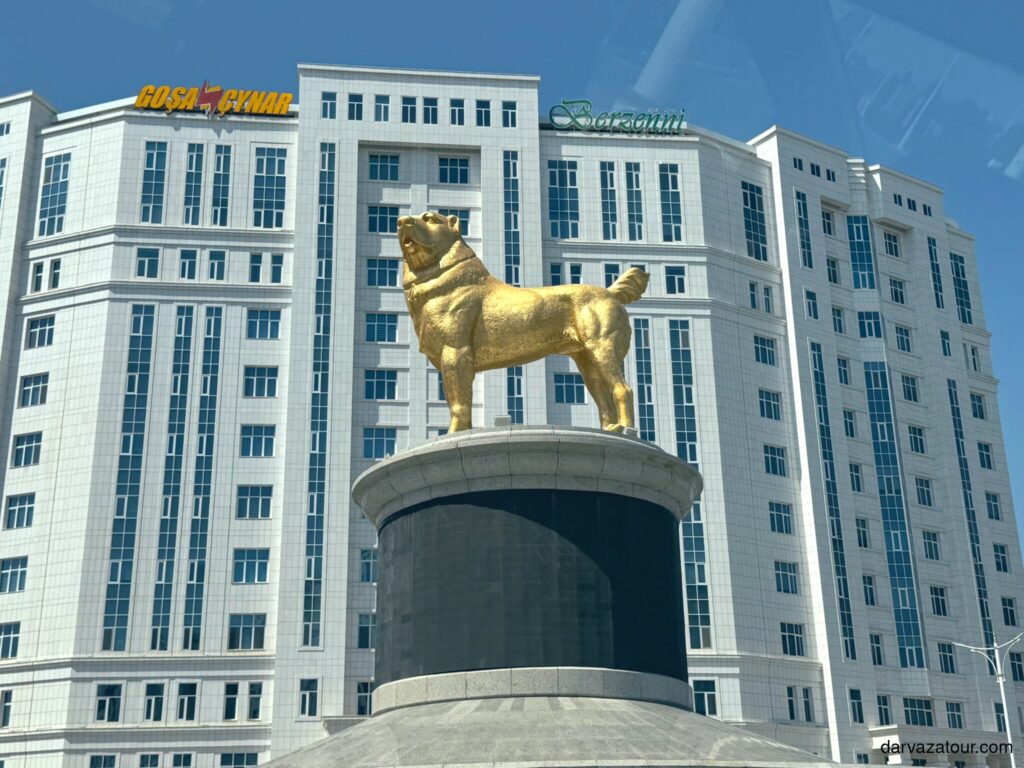
- A large bronze statue of Alabai has been erected in the capital, Ashgabat.
- There is also a commemorative event called "Turkmen Alabai Day," which involves contests, festivals, and exhibitions.
- There have also been books, films, TV dramas and documentaries on the subject of Alabai.
At international dog shows, tourist events, and even the Osaka Expo,
the Alabai have become a first encounter with Turkmenistan for many people.
Even after returning home, I may forget the names of cities and proper nouns of the desert,
but this impression remains with me for a long time.
"Ah, that country.The country with the giant white dog that isn't afraid of wolves even at night."
Where tourists can meet Alabai
If you travel to Turkmenistan, there's a good chance you'll see an Alabai in person
, not just as an "internet dog."
- Desert village on the way to Darvaza (gas crater)
- Karakum Desert Rangelands
- Private home garden
- On the outskirts of a town or village
In these places, Alabai live quite naturally as part of everyday life.
Simple rules to follow when meeting an Alabai
- Do not approach without the owner.
- Listen carefully to your guide's instructions.
The local people and your guide know the personalities of the local dogs best. - Even if you feel like petting them, don't run up to them.
From a distance, watch
the Alabai standing silently on a small hill in the distance, gazing intently towards the horizon.
That alone should show you that this dog is not "just a big dog."
If the owner is nearby...
If the owner is nearby and says "It's okay,"
- Stroking the Alabai,
- Try hugging them,
- They play around with each other like they're competing for strength,
- Let's go for a quick run together
You can also do this.
Once you feel its size and kindness, and its calm gaze that seems to be testing you,
Why is this dog called a "legendary dog"?
I'm sure you'll understand a little better.