

Kutlug Timur Minaret in Kunya-Urgench, Turkmenistan
Kutlug Timur Minaret is one of the most recognizable landmarks of Kunya-Urgench and one of the tallest surviving medieval minarets in Central Asia. Rising above the open archaeological landscape of northern Turkmenistan, the monument remains a striking reminder of the period when Kunya-Urgench was one of the major centres of historic Khorezm.
The minaret forms part of the UNESCO World Heritage Site of Kunya-Urgench and is especially notable for its height, tapering brick structure and decorative bands of patterned brickwork. Today, it is one of the key monuments visitors encounter when exploring the ancient city.
History of Kutlug Timur Minaret
The origins of the Kutlug Timur Minaret go back to the medieval period of Kunya-Urgench, when the city was developing into one of the most important centres of Khorezm. UNESCO documentation dates the structure approximately to the early 11th century, although the exact chronology of the monument remains uncertain.
The minaret later became associated with Kutlug Timur, the 14th-century ruler of Khorezm. During his rule, major restoration and construction works were carried out in Kunya-Urgench, and historical accounts indicate that the earlier minaret was restored, completed or substantially repaired during this period.
Despite the destruction and decline that affected much of the ancient city over the centuries, the Kutlug Timur Minaret survived and remained one of the most prominent monuments on the skyline of Kunya-Urgench. Its survival makes it an important link between the city’s earlier medieval development and the later flourishing of architecture under the rulers of Khorezm.
Architecture and Design of Kutlug Timur Minaret
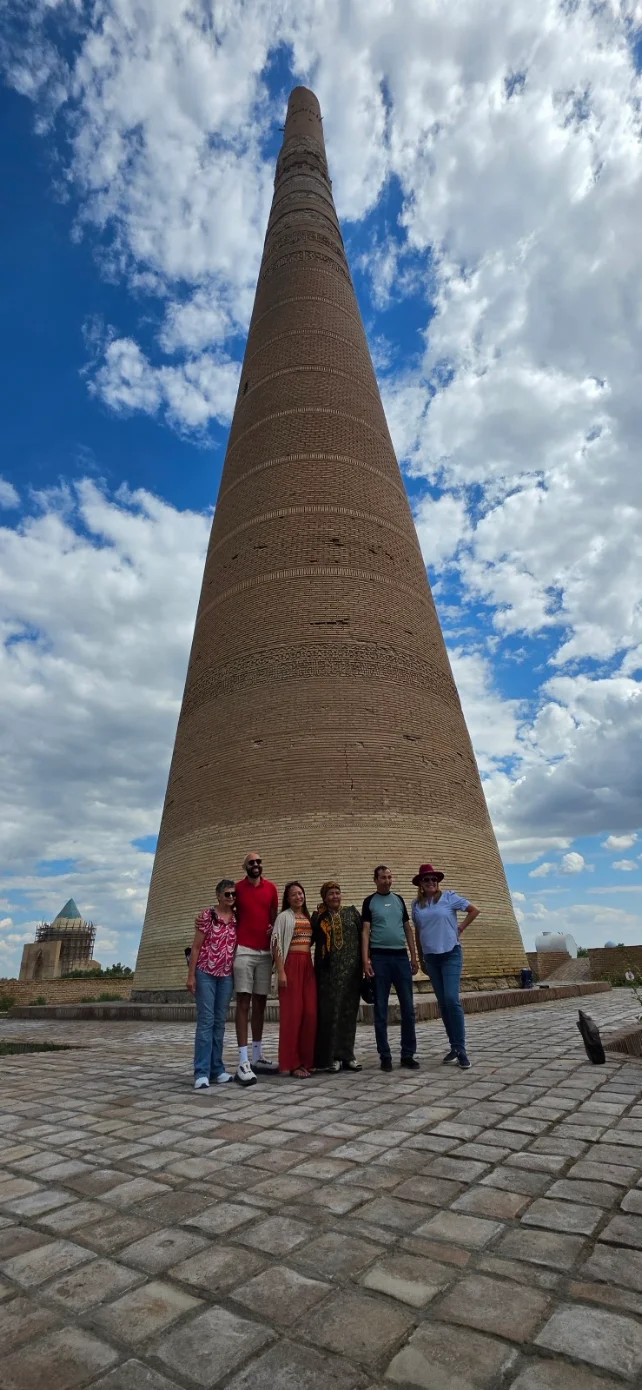
The Kutlug Timur Minaret is remarkable for its tall, tapering form and the precision of its brick construction. The tower rises to approximately 60 metres, with a diameter of about 12 metres at the base narrowing to around 2 metres near the top. This gradual narrowing gives the structure its distinctive slender silhouette and makes it visible from a considerable distance across the open landscape of Kunya-Urgench.
The exterior is built from fired brick and decorated with carefully arranged geometric patterns. Horizontal bands divide the surface of the tower, creating a strong visual rhythm while emphasizing its height. Decorative brickwork and inscriptions were used not simply as ornament, but as part of the overall architectural composition.
Inside the minaret, a spiral staircase once provided access toward the upper part of the tower. According to Turkmenistan’s official account, the staircase consisted of 145 steps and was originally reached from the roof of a mosque that once stood directly beside the minaret but has not survived.
What makes the Kutlug Timur Minaret especially impressive today is the combination of monumental scale and relatively restrained decoration. Rather than relying on large areas of colourful tilework, its visual character comes primarily from the proportions of the tower, the texture of the brickwork and the repeating geometric bands that wrap around its surface.
What to Look for When Visiting Kutlug Timur Minaret
When you first approach the Kutlug Timur Minaret, the most striking feature is its scale. From a distance, the tower rises clearly above the flat archaeological landscape of Kunya-Urgench, making it easy to understand why it became one of the city’s most recognizable landmarks.
As you move closer, pay attention to the surface of the minaret. The exterior is covered with bands of patterned brickwork, and the decoration becomes much easier to appreciate at close range. The alternating geometric designs create subtle changes in texture and shadow across the tower, especially in strong sunlight.
It is also worth stepping back again after viewing the details up close. From a wider perspective, the gradual narrowing of the tower becomes much more apparent, and the proportions of the Kutlug Timur Minaret can be seen in relation to the surrounding ruins and open landscape.
For photography, both close and distant viewpoints offer something different. Close views reveal the brick decoration and craftsmanship, while wider compositions show the minaret as part of the historic landscape of Kunya-Urgench.
Visiting Kutlug Timur Minaret in Kunya-Urgench
The Kutlug Timur Minaret is best visited as part of a wider exploration of Kunya-Urgench, rather than as an isolated monument. The historic area contains several important sites from different periods of Khorezm’s history, including Turabek Khanum Mausoleum, Sultan Tekesh Mausoleum, Il-Arslan Mausoleum and the Najmuddin Kubra Mausoleum.
For travelers arriving from Khiva, Kunya-Urgench can be reached after crossing the Shavat border into Turkmenistan. Because of its location in northern Turkmenistan, the ancient city is also a natural stop on overland itineraries continuing south through the Karakum Desert toward the Darvaza Gas Crater and later Ashgabat.
When visiting the minaret, it is worth allowing enough time to explore the surrounding monuments rather than viewing the tower only from the road. Together, the minaret, mausoleums and archaeological remains give a much clearer impression of the scale and historical importance of medieval Kunya-Urgench.
For a complete overview of the ancient city, its main monuments and practical travel information, see our Kunya-Urgench Travel Guide.