

Ancient Nisa, Turkmenistan
A UNESCO-listed royal fortress of the Parthian Empire, Old Nisa rises just 18 km from Ashgabat beneath the Kopet Dag mountains. Here is its story, what you will see and how a visit fits into your tour.
Ancient Nisa: Royal Fortress of the Parthians
From the road, Old Nisa looks like a hill of earth. More than two thousand years ago it was a royal fortress of the Parthian Empire, one of the great powers of the ancient world. Here is why it is worth an hour of your day.
The Fortress of Mithridates
Clay documents found in the ruins call the fortress Mithradatkert, after Mithridates I, the king who turned Parthia into an empire in the 2nd century BC.
An empire that rivalled Rome
For almost five hundred years the Parthians ruled from Central Asia to Mesopotamia and stood up to Rome, famously defeating a Roman army at Carrhae in 53 BC.
A UNESCO World Heritage Site
The Parthian Fortresses of Nisa joined the UNESCO list in 2007. With Ancient Merv and Kunya-Urgench, it is one of Turkmenistan's great historic sites.
Treasures from the ruins
Excavations uncovered carved ivory drinking horns (rhytons), statues and coins mixing Greek and local styles. See them at the National Museum in Ashgabat.




What You'll See at Old Nisa
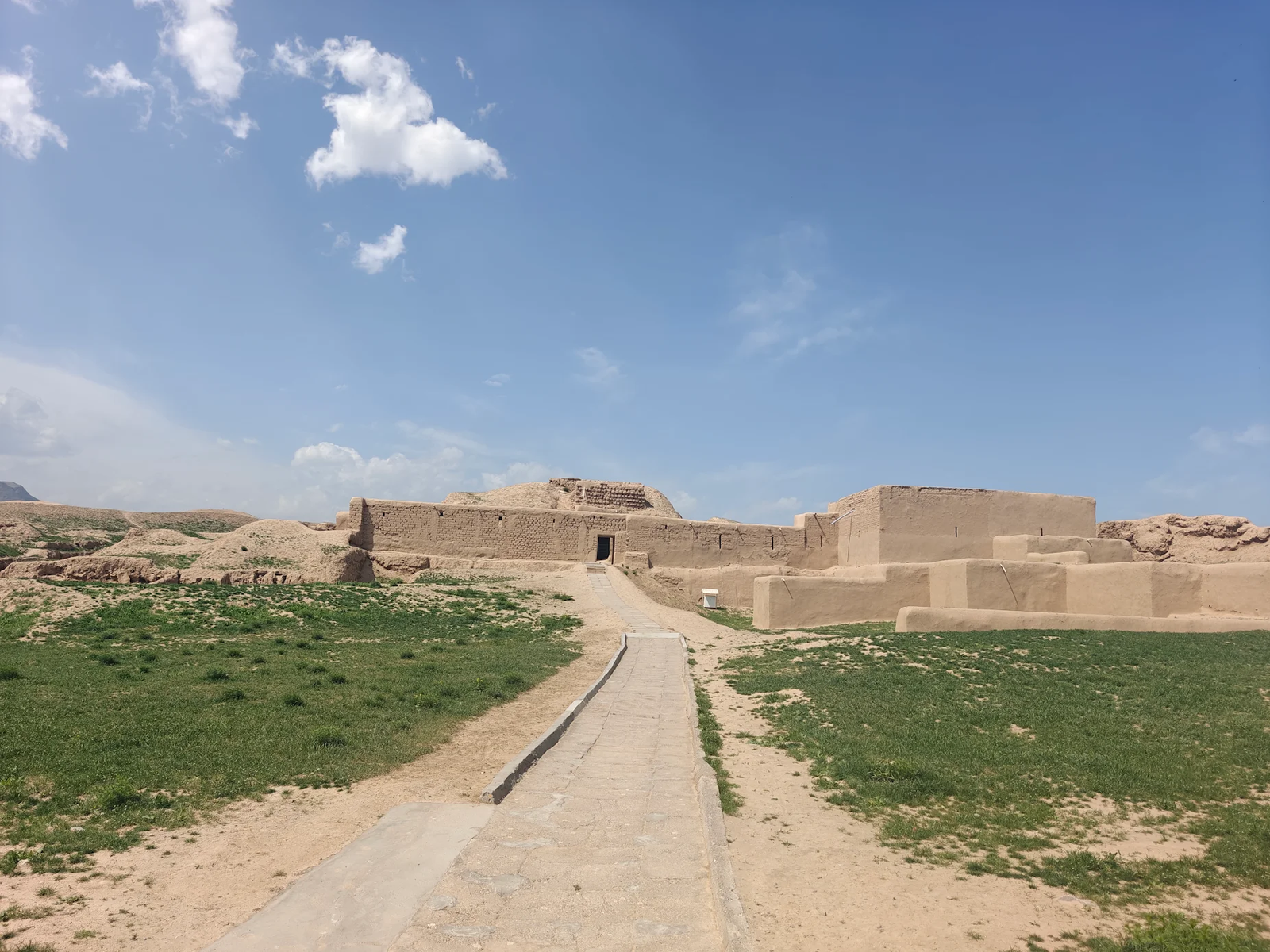
Old Nisa sits on a natural hill just outside the village of Bagyr. Most of what survives is mud-brick walls and foundations, so a guide makes a big difference: with the right story, the empty halls come back to life. A walk around the site takes about an hour.
The great earthen walls
The fortress is surrounded by massive mud-brick walls with towers, built in a five-sided shape on top of the hill. Walking along them gives you the best sense of how big and well protected the royal fortress once was.
The Round Hall
A large circular hall in the heart of the fortress. Archaeologists believe it was a temple or a place to honour the royal ancestors. It is one of the most striking spaces on the site.
The Square Hall
The biggest hall of Old Nisa, once roofed and decorated with columns and statues. It was probably used for royal ceremonies and receptions, and some of the most famous finds from Nisa came from this part of the fortress.
Views to the Kopet Dag
From the top of the walls you look across the plain to the Kopet Dag mountains on one side and towards Ashgabat on the other. Morning and late afternoon light makes the clay walls glow, so bring your camera.
How to Visit Ancient Nisa
Nisa is only a short drive from Ashgabat, and the visit takes about an hour, so it fits easily into a day in the capital. Here are three ways to plan it.
With the Akhal-Teke horses on an Ashgabat day
In the morning you walk through Old Nisa with your guide, while the air is still cool. Then you continue to an equestrian complex in Ashgabat to meet the famous Akhal-Teke horses. History and the golden horses in one easy half day.
On a two-day stay in Ashgabat
With two days in the capital, you have time for Nisa, the horses and the city's marble monuments without rushing. Our Ashgabat travel guide shows what else you can see.
Come in spring
In spring the plain around Nisa turns green, the air is mild and the Kopet Dag stands sharp behind the clay walls. It is the most beautiful time to walk the fortress and take photos.
We plan the day around your route, dates and interests. See tours with Nisa ↓
Tours with Ancient Nisa
These routes include a day in Ashgabat, where Nisa is just a short drive away. Any tour with time in the capital can include the fortress on request.

3-Day
Private / Small Group
3-Day Turkmenistan Tour from Khiva to Bukhara: Darvaza, Ashgabat & Ancient Merv
Available from: Khiva / Shavat
Cross Turkmenistan from Khiva to Bukhara in 3 days: Kunya-Urgench, a night at the Darvaza Gas Crater, white-marble Ashgabat and Ancient Merv.
1 traveler — US$ 1.173 pp
4+ travelers — US$ 632 pp
5-Day
Private / Small Group
5-Day Turkmenistan Tour from Khiva to Bukhara: Darvaza, Ashgabat & Ancient Merv
Available from: Khiva / Shavat
Cross Turkmenistan from Khiva to Bukhara: a night at the Darvaza Gas Crater, Ashgabat, Nokhur and the Kow-Ata underground lake, ancient Nisa and Merv.
1 traveler — US$ 1857 pp
4+ travelers — US$ 744 pp

4-Day
Private / Small Group
4-Day Tour: Farap → Shavat via Merv, Mary, Ashgabat & Darvaza
Available from: Bukhara / Farap
Explore Merv, Mary, Ashgabat and the Darvaza Gas Crater on a 4-day overland tour from Farap to Shavat, combining Silk Road history, city sightseeing and the Karakum Desert.
1 traveler — US$ 1311 pp
4+ travelers — US$ 734 pp
Ancient Nisa: FAQ
How far is Nisa from Ashgabat?
Old Nisa is about 18 km west of central Ashgabat, near the village of Bagyr. The drive takes around 30 minutes.
How much time do I need at Nisa?
About an hour is enough to walk around the fortress with your guide, see the main halls and enjoy the views of the Kopet Dag.
Is the entrance ticket included in your tours?
Yes. Entrance tickets are included in all our tours that visit Nisa. Any tour with a day in Ashgabat can add a visit on request.
What is the difference between Old Nisa and New Nisa?
Old Nisa was the royal fortress with palaces and temples. New Nisa was the city where ordinary people lived. Travellers visit Old Nisa, where the main ruins and the best views are.
Why is Nisa a UNESCO World Heritage Site?
Nisa was one of the first royal centres of the Parthian Empire, a power that ruled from Central Asia to Mesopotamia and rivalled Rome. Its ruins show a unique mix of local and Greek traditions, and it was added to the UNESCO list in 2007.
What else can I see on the same day?
Nisa pairs perfectly with the Akhal-Teke horses at an equestrian complex in Ashgabat. You can also add the white-marble city or the National Museum, where finds from Nisa are on display. See our Ashgabat travel guide.
When is the best time to visit Nisa?
Spring (March to May) and autumn (September to November) are the most pleasant. In summer there is little shade on the site, so we visit early in the morning.
Can I visit Nisa without a tour?
Independent tourism is not allowed in Turkmenistan, so visitors travel with a licensed local operator and guide. We arrange transport, the guide and the visit, and your guide brings the ruins to life with the story of the Parthians.
Continue Exploring Turkmenistan
Want to Walk Through Ancient Nisa?
Tell us your dates and route, and we'll suggest the best way to fit Nisa into your trip.